Understanding FDA News About Compounded GLP-1s
.jpg)

In the past year, the headlines about the FDA and GLP-1 medication may have seemed confusing. You may be asking yourself, “Are there changes to my medication?” “Do I have to stop taking my weight loss medication?” “Are compounded GLP-1s still safe?”
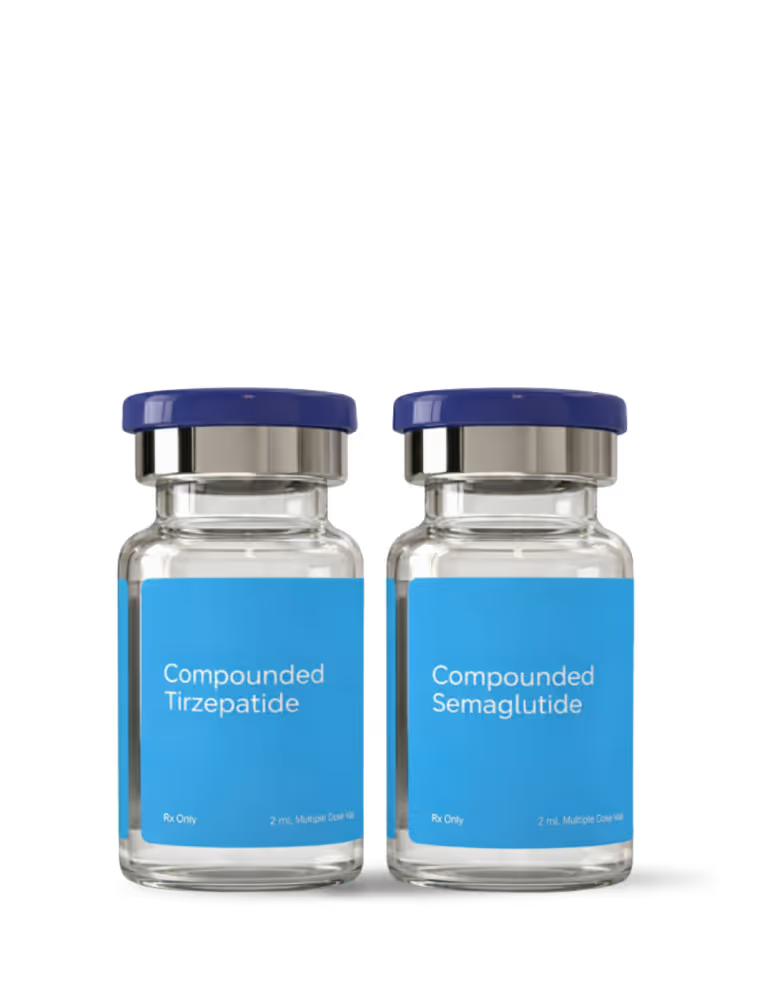
If you use compounded semaglutide or compounded tirzepatide, these FDA announcements may worry you.
Let’s break down how recent FDA announcements impact compounded GLP-1 medications, with dates, distinctions, and plain-English explanations.
Key Takeaways: Understanding the Regulation Changes to Compounded Weight Loss Medication
- The FDA has taken enforcement actions against unlicensed sellers and unregulated bulk production, not licensed medical compounding through state-licensed 503A pharmacies with valid prescriptions.
- State-licensed 503A pharmacies—which compound medications for individual patients based on a licensed healthcare provider's prescription—remain legally authorized.
- Compounded semaglutide and compounded tirzepatide are still available through Get Thin MD.
- The FDA ending the 'drug shortage' designation changed what certain bulk compounders could do, but it did not eliminate licensed medical compounding.
Questions about compounded GLP-1 medication? Reach out to your care team.
[BIG CTA GRAPHIC/BUTTON HERE]
A Timeline of FDA Actions Affecting Compounded GLP-1s
The FDA took a series of targeted actions between late 2024 and early 2026. Here is a brief timeline of FDA announcements and actions that impact compounded GLP-1 medications:
- October-December 2024: The FDA removes tirzepatide from its drug shortage list in October, then formally confirms the tirzepatide shortage is resolved in December. The FDA provided a grace period for 503B outsourcing facilities to phase out production.
- February 21, 2025: The FDA announces the semaglutide drug shortage is resolved.
- May 2025: Grace periods end for compounded semaglutide and compounded tirzepatide from 503B outsourcing facilities, meaning mass-market bulk production must stop.
- February 2026: The FDA warns companies illegally selling unapproved GLP-1 products, targeting false labeling, unlicensed sellers, and untested salt forms.
- February 9, 2026: The FDA announces plans to restrict ingredients used in mass-marketed, unlicensed GLP-1 products.
- April 1, 2026: The FDA clarifies policies for compounders as GLP-1 supply stabilizes. The FDA also confirms conditions under which 503A compounders can continue to operate.
- April 30, 2026: The FDA proposes excluding GLP-1 medications from the 503B Bulk Drug Substances List. Public comment period is open through June 29, 2026.
Which of these actions are particularly important for someone on a compounded GLP-1 medication? The May 2025 deadline that affected 503B outsourcing facilities—large-scale bulk producers—stands out to us. This deadline did not apply to 503A pharmacies, which compound for individual patients with valid prescriptions.
Two Types of Compounding (and Why This Distinction Matters)
There are 2 categories of compounding pharmacy in the US—503B outsourcing facilities and 503A pharmacies. They operate under different sections of federal law, have different legal authority, and the FDA's actions affected them differently.
503B Outsourcing Facilities
These are large-scale operations that produce compounded medications in bulk and distribute them to medical practices and pharmacies across the country. Under federal law, they can only compound certain medications if they meet one of two criteria: either they’re on the 503B Bulk Drug Substances List, or the medications are on the FDA's active drug shortage list.
When the shortage ends, their legal authority to compound those specific medications also ends. This is the category most affected by the FDA's recent actions related to compounded GLP-1s. The grace periods that ended in May 2025 applied to 503B facilities.
503A Pharmacies
These pharmacies compound medications for individual patients, one prescription at a time, based on a valid prescription from a licensed healthcare provider. They operate under Section 503A of the Federal Food, Drug, and Cosmetic Act.
503A pharmacies are not limited to drug shortage situations in the same way 503B pharmacies often are. 503A pharmacies are regulated primarily by state pharmacy boards, and requirements vary state by state.
503A pharmacies must follow USP standards set by the US Pharmacopeia, an independent scientific organization that establishes benchmarks for medication quality, purity, and safety.
Unlike 503B facilities, 503A facilities are not required to register with the FDA.
Why This Distinction Matters for Compounded GLP-1 Users
When the drug shortage ended, 503B bulk compounders lost their legal basis for GLP-1 compounding. But 503A pharmacies, which compound for individual patients with valid prescriptions, continued to operate legally under a different authority.
The FDA’s announcements—and headlines—could be misunderstood as applying to all compounding. They do not. Many of these regulation changes only affect 503B outsourcing facilities.
What Are "Unapproved GLP-1 Products"?
The FDA's February 2026 enforcement announcement specifically targeted companies selling products that:
- Were falsely labeled as GLP-1 medications but had never been FDA-reviewed for safety or effectiveness.
- Contained "salt forms" of GLP-1 medications (chemical variations that may not have the same chemical and pharmacologic properties as the active ingredient in the approved drug).
- Were marketed for "research purposes" but sold directly to consumers for weight loss without any licensed provider involvement.
- Were imported using potentially dangerous active pharmaceutical ingredients.
- Had no licensed healthcare provider involved in the prescribing process.
What the February 2026 enforcement announcement was NOT targeting:
- Licensed 503A pharmacies compounding for individual patients with valid prescriptions.
- Telehealth programs with licensed provider oversight and state-licensed pharmacies.
- Compounded semaglutide or compounded tirzepatide dispensed through licensed programs.
Is Compounded Medication Still Legal? Yes, From 503A Pharmacies
After the GLP-1 drug shortage was resolved, compounded GLP-1 medication from 503A pharmacies remained legal under the following conditions:
- A licensed healthcare provider must write an individualized prescription for a specific patient.
- The prescription is based on a medical determination that the medication is appropriate for that individual.
- The pharmacy compounds the medication using FDA-registered active pharmaceutical ingredients (APIs).
- The pharmacy meets USP compounding standards and operates as a state-licensed 503A facility.
- The medication is not mass-produced or marketed to the general public.
The FDA's April 2026 clarification explicitly reminded compounders of the conditions under which 503A pharmacies can continue to operate. This was a clarification of existing rules, not a ban.
Get Thin MD works with state-licensed 503A pharmacies. Start your GLP-1 consultation today.
[BIG CTA GRAPHIC/BUTTON HERE]
Are Get Thin MD Customers on Compounded GLP-1 Medications Affected by FDA Enforcements?
No, customers on compounded semaglutide and compounded tirzepatide through Get Thin MD are not impacted by these enforcements. Get Thin MD works with state-licensed 503A pharmacies. Here is what that means in practice:
- Your compounded semaglutide or compounded tirzepatide is prescribed by a licensed healthcare provider based on your specific medical history.
- Your prescription is individualized, not mass-produced or mass-distributed.
- The pharmacy that prepares your medication operates under state licensure and federal 503A rules.
- Your medication comes with provider oversight, Care Coach support, and Registered Dietitian access.
What about the FDA's proposed 503B exclusion?
The FDA's April 30, 2026 proposal affects 503B outsourcing facilities, not 503A pharmacies. As of May 2026, this proposal is in a public comment period through June 29, 2026. No final rule has been issued.
Frequently Asked Questions About FDA Changes to Compounded GLP-1 Medications
Q: Is the FDA going to stop pharmacies compounding semaglutide?
The FDA's actions to date have not stopped 503A pharmacy compounding of semaglutide. What ended was the broad authorization for 503B bulk compounders, which relied on the drug shortage designation. 503A pharmacies, which compound for individual patients with a valid prescription from a licensed provider, continue to operate legally.
The FDA proposed excluding GLP-1 medications from the 503B Bulk Substances List on April 30, 2026, but this proposal is still in the public comment period and has not become a final rule as of May 2026.
Q: Can you still get compounded semaglutide in 2026?
Yes, through licensed programs that use 503A pharmacies with valid provider prescriptions. As of May 2026, compounded semaglutide is available through Get Thin MD, which works with state-licensed 503A pharmacies and requires a licensed provider prescription.
Q: Will doctors still be able to prescribe compounded semaglutide?
Yes, licensed healthcare providers can still write prescriptions for compounded semaglutide or compounded tirzepatide. 503A pharmacies can still fill those prescriptions. The legal framework that allows this (Section 503A of the Federal Food, Drug, and Cosmetic Act) has not changed.
Q: Are compounded GLP-1s going away entirely?
Not through the licensed 503A pathway. What went away was large-scale bulk compounding from 503B outsourcing facilities, which was only authorized during the drug shortage period, from early 2022 until resolved in 2025. Licensed 503A compounding—patient-specific, provider-prescribed—remains legal.
Why Get Thin MD
Get Thin MD is a national telehealth weight loss program offering compounded semaglutide and compounded tirzepatide through licensed healthcare providers and state-licensed 503A pharmacies.
When you join, you get:
- A licensed healthcare provider review of your medical history to determine whether treatment is medically appropriate for you.
- If eligible, your medication is dispensed from a state-licensed 503A pharmacy.
- Access to Care Coaches, available 7 days a week to support your progress.
- Access to Registered Dietitians to help you build healthy habits that support weight loss progress.
- No insurance required. No in-person visits needed.
When Compounded GLP-1 Medication May Not Be the Right Fit
Compounded GLP-1 medication is not appropriate for everyone. A licensed provider evaluation will review if:
- You have a personal or family history of any medical conditions that may prevent the use of GLP-1 medications.
- You are pregnant or planning to become pregnant.
- You obtained compounded GLP-1 medication from another provider that is no longer able to provide your medication. Have a discussion with your licensed provider before continuing or switching to a new program.
When to Talk to Your Licensed Healthcare Provider
If FDA news is raising questions about your compounded GLP-1 medication, bring these questions to your provider:
- Ask: "Does the pharmacy that fills my prescription operate as a licensed 503A pharmacy?"
- Ask: "Is my current prescription still valid and is my medication still available?"
- Ask: "Are there any changes I need to know about in how my medication is sourced?"
- Ask: "If the regulatory landscape changes further, what does that mean for my treatment?"
Your licensed healthcare provider is your most accurate, current source of information.
For full safety details, always review our Important Safety Information page.
Compounded GLP-1 medication is still available through Get Thin MD. Start your consultation today—no insurance needed.
[BIG CTA GRAPHIC/BUTTON HERE]
The Bottom Line
The FDA's 2024–2026 actions ended large-scale bulk compounding from outsourcing facilities. They also took action against unlicensed sellers and dangerous products.
They did not eliminate licensed medical compounding through 503A pharmacies, nor did they stop licensed healthcare providers from prescribing compounded GLP-1 medication for individual patients.
Important Safety Information
Get Thin connects patients with licensed providers who may prescribe medication through state-licensed pharmacies. Prescription medication only available if prescribed after an online consultation, as applicable, with a healthcare provider. Physicians may prescribe compounded medications as needed to meet medical necessity or drug shortages. The FDA does not review or approve any compounded medications for safety or effectiveness. Results may vary. Please visit the Important Safety Information page.