FDA Peptide Reclassification 2026: What It Means If You're on a Weight Loss or Wellness Program


You probably saw the headlines in April and May 2026. Something about the FDA, peptides, and weight loss medications all changing at once.
The stories overlapped. It was hard to know what applied to you.
Here is the clear version: in the same 7-day window, the FDA made 2 completely separate regulatory moves. They involve different medications, different timelines, and very different impacts depending on what program you are on.
This post breaks both down so you know exactly where things stand.
Key Takeaways: FDA Peptide Reclassifications, Simplified
- On April 23, 2026, the FDA removed 12 wellness peptides from a restricted "do not compound" list, effective immediately.
- On April 30, 2026, separately, the FDA proposed restricting large-scale manufacturing of compounded GLP-1 weight loss medications.
- These are 2 completely different regulatory actions with different medications, different timelines, and different legal pathways.
- The GLP-1 compounding proposal is not yet finalized as of writing this article. A public comment period is open through June 29, 2026.
- Patient-specific compounding through a licensed 503A pharmacy follows different legal rules than bulk 503B manufacturing.
Ready to start a weight loss program supported by a qualified care team? Get started today.
[BIG CTA GRAPHIC/BUTTON HERE]
Two FDA Actions. Two Very Different Topics.
Spring 2026 brought 2 major FDA announcements within 1 week of each other.
Because both stories used the word "peptide" and both involved compounding pharmacies, this created a lot of confusion.
- Action 1 (April 23, 2026): The FDA removed 12 peptides, sometimes marketed for wellness or recovery purposes, from a restricted category. This opens the door for licensed compounding pharmacies to potentially prepare these peptides again, with individual patient prescriptions.
- Action 2 (April 30, 2026): The FDA proposed that semaglutide, tirzepatide, and liraglutide should not appear on a list that allows large-scale commercial compounding. This is a separate proposal still in a public comment period as of writing this article.
Same week. Very different medications. Very different outcomes.
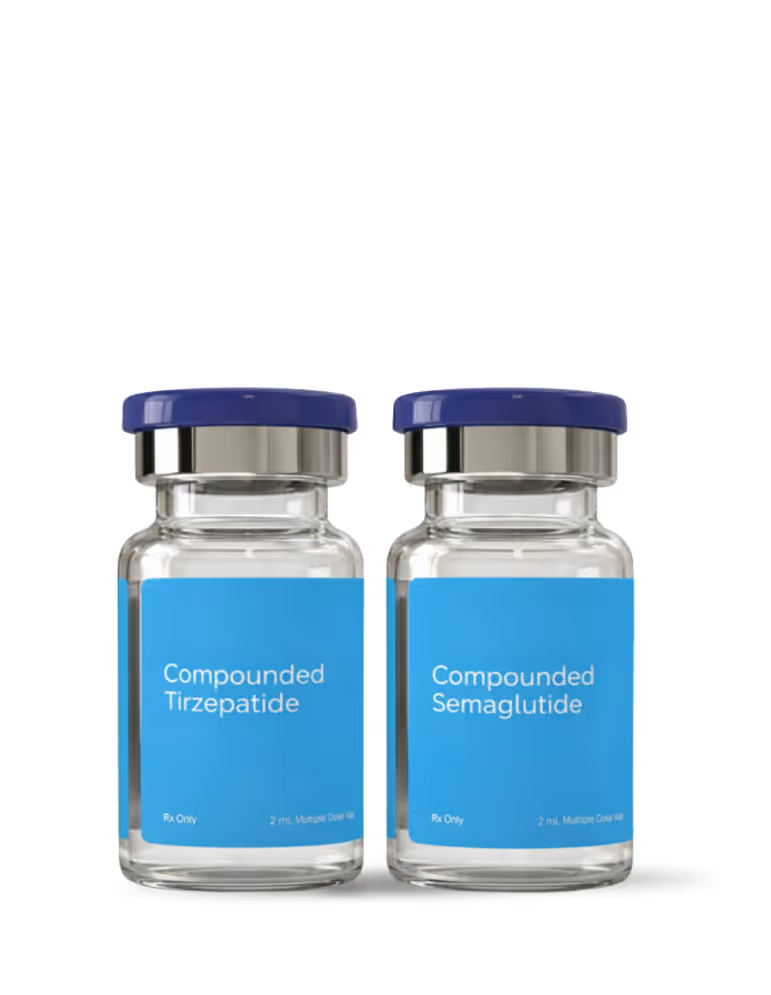
Remember, compounded medications are not FDA-approved and are prepared by licensed pharmacies when appropriate based on a provider’s prescription.
What Is the FDA Peptide Reclassification? (The April 23 Change)
For years, a group of peptides appeared on the FDA's Category 2 list.
Category 2 was the FDA's label for bulk drug substances it considered to have "significant safety concerns" for compounding. Being on that list meant licensed compounding pharmacies could not prepare them for patients.
On April 23, 2026, 12 of those peptides were officially removed from Category 2, effective immediately. The companies that originally nominated those peptides for Category 2 withdrew their nominations. Without active nominations, the FDA removed them from the restricted list. This was an administrative removal, not a new safety finding.
Removal from Category 2 does not mean these peptides are FDA-approved. They are not at this time. What it means is that the legal barrier to compounding them was lifted.
The next step: the Pharmacy Compounding Advisory Committee (PCAC) is scheduled to meet July 23–24, 2026. That meeting will consider whether any of the reclassified peptides should be added to the 503A approved bulks list, giving them clearer legal standing for individual-patient compounding going forward.
Which 12 Peptides Were Removed from the Restricted List?
The 12 peptides removed from Category 2, effective April 23, 2026:
- BPC-157 (Body Protection Compound-157)
- TB-500 (Thymosin Beta-4 fragment)
- MOTS-C
- GHK-Cu (injectable form only)
- Melanotan II
- Semax
- LL-37
- DiHexa
- DSIP (Delta Sleep-Inducing Peptide)
- Epitalon
- KPV
- PEG-MGF
This list does NOT include semaglutide, tirzepatide, or liraglutide. Those are FDA-approved medications governed by a completely separate regulatory pathway.
What Do These Peptides Do? (Weight Loss and Wellness Relevance)
Not all of these peptides are related to weight loss. But several have been studied for metabolic and body composition purposes.
MOTS-C is a mitochondrial-derived peptide. Small studies have examined its role in insulin sensitivity and metabolic regulation. It is not an approved weight loss treatment, and research remains early-stage. Results vary.
BPC-157 is among the most studied peptides on this list. It has been researched for tissue repair, gut health, and inflammation. Some people use it as a recovery support tool alongside a weight loss program, but it is not a weight loss medication.
TB-500 (Thymosin Beta-4 fragment) has been studied in the context of injury recovery and inflammation. Like BPC-157, it is not a weight loss treatment.
DSIP (Delta Sleep-Inducing Peptide) is named for its potential effect on sleep quality.
Poor sleep is closely linked to weight, hunger hormones, and metabolic function. So, for some people, sleep-related support may be part of a broader wellness approach. This is not a direct weight loss claim for DSIP. Talk to your licensed healthcare provider about whether any peptide is appropriate for you.
Most of these peptides are still far from routine clinical use. Removal from Category 2 is a regulatory step, not a green light to use them as standalone treatments. Always talk to a licensed healthcare provider before starting any peptide.
What About GLP-1 Medications? (The April 30 Proposal)
This is the part that most directly affects people on compounded GLP-1 weight loss programs.
On April 30, 2026, the FDA announced a proposal to exclude semaglutide, tirzepatide, and liraglutide from the 503B bulks list.
Here is what "the 503B bulks list" means in plain terms:
The 503B bulks list is a specific legal pathway that allows large-scale commercial outsourcing facilities to compound medications in bulk—without a patient-specific prescription—for distribution to healthcare facilities. Think of it as the legal basis for large-scale GLP-1 production through compounding.
The FDA's position: the national shortage of these medications has been resolved. Tirzepatide was removed from the shortage list in December 2024. Semaglutide was removed in February 2025. Without an active drug shortage, 503B outsourcing facilities lose the primary legal basis for bulk GLP-1 compounding.
This proposal is not yet final. A public comment period is open through June 29, 2026. The FDA will review all submitted comments before issuing a final decision.
Wondering whether a compounded GLP-1 program is right for you? When you start with Get Thin MD, a licensed healthcare provider reviews your health history and helps you decide.
[BIG CTA GRAPHIC/BUTTON HERE]
What Is the Difference Between 503A and 503B Compounding?
This distinction matters a lot for understanding what remains available.
503B outsourcing facilities produce large batches of medications for distribution to multiple healthcare facilities or patients, often without individual prescriptions. The April 30 FDA proposal targets this 503B pathway for GLP-1 medications.
503A pharmacies are traditional compounding pharmacies. They make medications for individual patients, based on a specific valid prescription from a licensed healthcare provider. They operate under a different legal framework than 503B facilities.
The 503A framework is not part of the April 30 FDA proposal. Patient-specific compounding through a licensed 503A pharmacy continues to operate under its own legal standards—though regulatory interpretation may change.
Here is the simplest way to understand it: if a pharmacy compounds a medication specifically for you, based on your licensed provider's prescription, that is legally distinct from a factory producing thousands of vials for general distribution.
The regulatory pressure in 2026 is primarily aimed at large-scale 503B bulk operations, not at individual patient care through licensed providers.
What This Means If You're Currently on a Compounded GLP-1 Program
If you are currently receiving compounded semaglutide or compounded tirzepatide through a telehealth program with licensed provider oversight, here is what to understand:
- The April 30 proposal targets large-scale 503B operations. Patient-specific programs operating through licensed 503A pharmacies may continue to operate subject to evolving regulatory guidance.
- The proposal is not yet final. The FDA will review public comments through June 29, 2026, before issuing any final rule.
- Work with a legitimate, licensed program. Programs that operate through licensed providers, prescribe for specific individual patients, and work with licensed pharmacies are on different legal footing than bulk-vial operations.
- Don't make any changes without talking to your provider. If you are currently on a compounded GLP-1 program, the best move is not to panic. Have a conversation with your licensed healthcare provider.
Many people report meaningful progress on compounded GLP-1 programs. Results vary. Your doctor will help you determine the right path forward as regulations continue to develop.
What to Watch For Over the Next Several Months
The regulatory landscape is still developing. Here is what matters next:
- June 29, 2026: Public comment period closes on the FDA's 503B GLP-1 exclusion proposal.
- July 23–24, 2026: PCAC meets to review whether reclassified peptides should be added to the 503A approved bulks list.
- After July 2026: The FDA will begin formal review of PCAC recommendations and consider next steps.
None of these steps automatically remove access overnight. The process involves public input at multiple stages.
Stay in contact with your licensed healthcare provider for updates specific to your program.
What We Found When We Compared Both FDA Announcements Side by Side
We reviewed the full text of both FDA announcements, released within 7 days of each other in April 2026. Here is what stands out when you look at them together:
- The peptide reclassification (April 23) was largely administrative. The companies that originally nominated those 12 peptides for Category 2 withdrew their nominations. The FDA removed them. This was not triggered by new safety research—it was driven by withdrawal of nominations.
- The GLP-1 proposal (April 30) was a proactive FDA position statement. The FDA explicitly stated it found no clinical need for outsourcing facilities to bulk-compound GLP-1 medications now that the drug shortages are resolved.
One action opens a door (peptide compounding eligibility returns). The other proposes closing a door (GLP-1 bulk manufacturing at 503B facilities). They are moving in opposite directions and have nothing to do with each other despite landing in the same news cycle.
Timing note: the GLP-1 comment period closes June 29, 2026. The PCAC peptide review is July 23–24, 2026. Both resolutions will likely land in the same summer 2026 window, which means another round of overlapping headlines is coming.
Why Get Thin MD
Get Thin MD is a national telehealth weight loss program. It connects you with a licensed healthcare provider who reviews your health history and determines whether treatment is appropriate.
If prescribed, you receive compounded semaglutide or compounded tirzepatide. shipped directly to you from a licensed pharmacy.
Your program includes:
- A licensed healthcare provider review of your health history.
- Unlimited access to Care Coaches for ongoing check-ins and support.
- Access to Registered Dietitians for personalized nutrition guidance.
- Free, discreet shipping with no surprise, dose-based price increases.
Get Thin MD works through licensed pharmacies with individual prescriptions. That means your care is built around the patient-specific model—the model that operates under different legal standards than the bulk-vial operations being targeted by the FDA's April 30 proposal.
Many people in the Get Thin MD program report feeling supported and heard for the first time. Results vary. A licensed healthcare provider will review your individual health history before recommending any treatment.
This Program May Not Be the Right Fit If...
Get Thin MD may not be the right option for everyone. This program may not be right for you if you:
- Are currently pregnant, planning to become pregnant, or breastfeeding.
- Have a personal or family history of a certain type of thyroid cancer (a licensed healthcare provider will screen for this).
- Have Type 1 diabetes or a condition that requires more specialized in-person management.
- Prefer in-person visits and hands-on care over a telehealth model.
- Are not comfortable with self-administered injections.
- Are looking for a quick fix rather than a supported, ongoing program with coaching.
Your licensed healthcare provider will go over your full health history and help determine whether this program is the right fit for your situation.
When to Talk to A Licensed Healthcare Provider
If you are currently on a compounded GLP-1 program, or considering one, these are good questions to bring to your next appointment:
Ask: "Is my pharmacy operating as a 503A or 503B facility?"
Ask: "If the FDA finalizes the 503B exclusion, how would that affect my access to medication?"
Ask: "Are there alternative options I should know about given the regulatory changes?"
Ask: "Should I change anything about my current program based on the recent FDA announcements?"
Do not adjust your dose, pause your medication, or switch programs without guidance from your licensed healthcare provider. For full safety details, see our Important Safety Information.
Talk to a licensed healthcare provider about your weight loss options. Get Thin MD makes it simple.
[BIG CTA GRAPHIC/BUTTON HERE]
The Bottom Line
In April 2026, the FDA made 2 separate but important regulatory moves. The peptide reclassification opens the door for 12 wellness peptides to return to compounding eligibility. The 503B GLP-1 proposal targets large-scale bulk manufacturing, not patient-specific programs operating through licensed providers.
If you are on a program structured around a licensed healthcare provider and a state-licensed pharmacy, the most important step is to stay informed and stay in contact with your care team. The regulatory landscape is still evolving. Your doctor is your best guide.
Important Safety Information
Get Thin connects customers with licensed providers who may prescribe medication through state-licensed pharmacies. Prescription medication only available if prescribed after an online consultation, as applicable, with a healthcare provider. Physicians may prescribe compounded medications as needed to meet medical necessity or drug shortages. The FDA does not review or approve any compounded medications for safety or effectiveness. Results may vary. Please visit see our Important Safety Information.